Model Minorities
In the fall semester of 2020, I took a class at Amherst College named Model Minorities taught by Professor Wendy Bergoffen and Professor Franklin Odo. The class explored Jewish and Asian American identity, their experiences in America, and the strange stereotype of the "model minority." A major part of the class revolved around a semester-long research project each student completed. This website, and the interviews, research, and analysis it presents, are my project.
Professor Bergoffen and Professor Odo gave us wide latitude to decide our projects' scopes, questions, and methods, so I decided to try something new. I am not a social scientist; I have never used the methods that I explored for this project. I eventually settled on an oral history to answer my own, personal questions: what did it mean that I was Jewish? Who were my family members, and what are their stories? Truth be told, I did not know much about the lives of my family members. Even my sister, the person with whom I have the most in common, surprised me with what she had to say. In between my questions about who these people with whom I grew up were, I asked them how they thought about Judaism and how they viewed claims about Asian and Jewish Americans that draw on the model minority stereotype.
Other projects in the class attempted to answer related questions with a more rigorous methodology — for example, questioning a certain, well-defined group of Jewish people about their views of the model minority stereotype. However, my goal for this project was different. I did not attempt to provide concrete answers to difficult sociological questions. Instead, my goal was to explore, see what I could find, and present what interested me.
Who are these people?
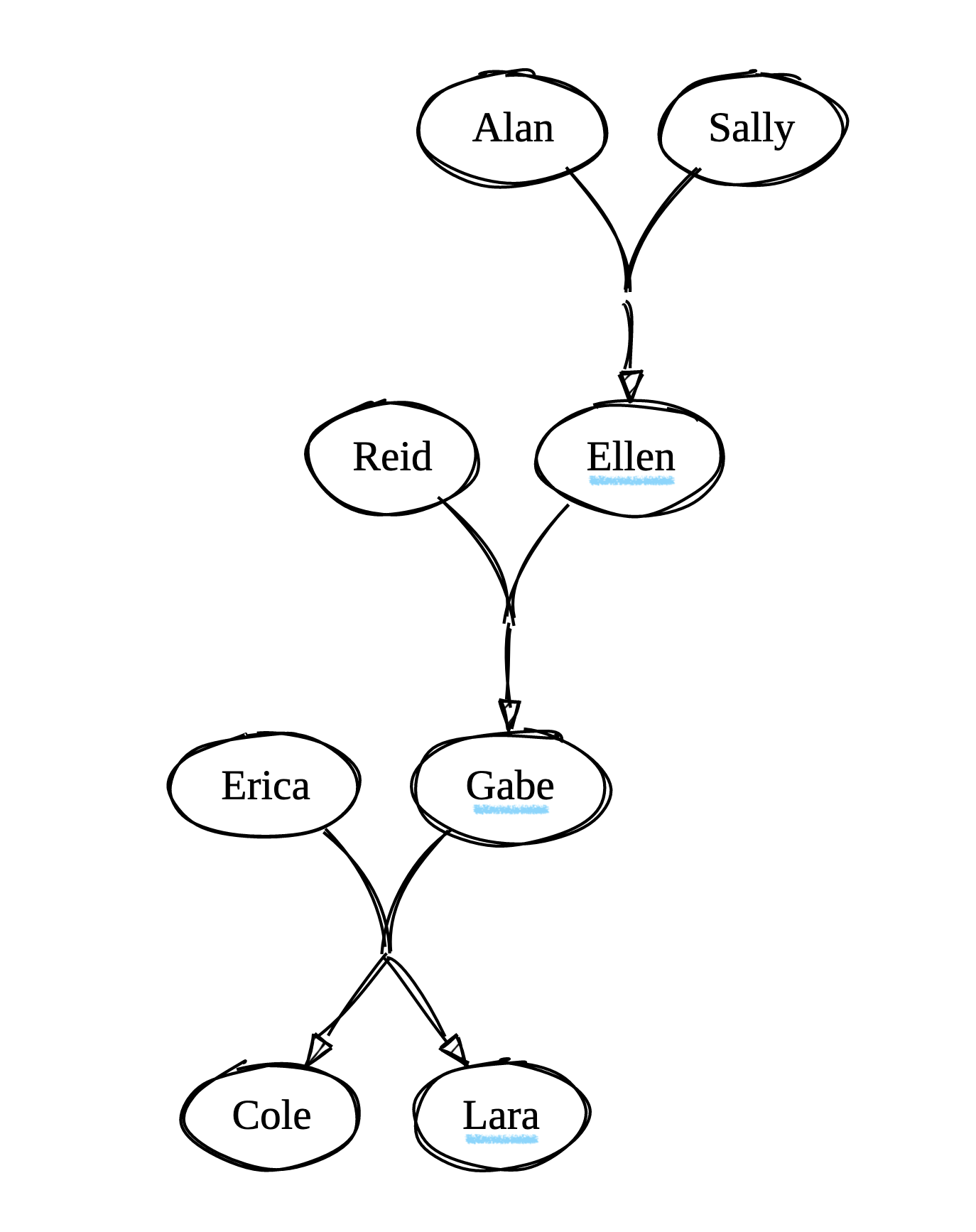
Though I have said their names and their relationships to me throughout the project, I think I should clearly explain who Ellen, Gabe, and Lara are.
Lara, a 19-year-old college student at Northeastern University, is my sister. She was born to Gabe and Erica in Minnesota.
Gabe is 45 years old and works for a large San Francisco software company from home in Minnesota. He was born to Ellen and Reid in Connecticut.
Ellen is 70 years old and recently retired from a second career as a nurse. She lives in Windham, Connecticut with her husband Kevin (also known as Gampy). Her parents are Alan and Sally. Some of her grandparents are immigrants; the others are the children of immigrants.
Methodology
Since my interviewees were simply family members, my project required no search for participants and no incentive for participating. Before each interview, I explained to the interviewee what the goal of the project was and what they reserved the right to do after taking part. In particular, participants were allowed to review the transcripts of their interview and redact any part for privacy's sake. At any point in time in the future, they can request that I remove all or part of their interview from this website. After ensuring that they knew what the project was, what participation entailed, and what control they had over their information, I asked them to sign an Informed Consent Form.
Then, I sent each interviewee my set of pre-interview questions along with a request that they spend some time thinking about the questions. I did not ask them to write responses. Instead, I designed the questions to make sure that my participants understood clearly what types of things we would talk about and to prepare them. The pre-interview questions were:
- What was your experience growing up? Who were your parents, and what were they like?
- What do you know about your grandparents, great-grandparents, and other ancestors who were Jewish? Where did they come from? Where did they go in the United States? What challenges did they face?
- Do you consider yourself to be Jewish? In which ways? What does it mean to be Jewish? Likewise, in which ways do you or do you not consider your children and parents to be Jewish?
- Have you experienced anti-Semitism? How?
- Jews are historically over-represented in certain fields and among high-achieving individuals. For example, as of 2010, Jews made up 27 percent of Nobel physics laureates, 21 percent of Ivy League student bodies, and 37 percent of Oscar-winning directors.1 Why do you think this is?
- Jewish over-representation has led to claims that Jews are a sort of "model minority" compared with other groups that are numerical minorities of the United States, like Black Americans, that are under-represented in the same arenas. Do you think of Jews as a "model minority"? Why or why not?
- Since the 1960s, some commentators and sociologists have claimed that Asian Americans are a "model minority." For example, Asian Americans are over-represented in medicine, where 17 percent of all active physicians identify as Asian, and in Ivy League student bodies.2 Do you think that Asian American over-representation is related to Jewish over-representation? Why would or why would you not term Asian Americans a "model minority"?
Finally, I interviewed each participant over Zoom, a video calling software. Each interview lasted between an hour and a half and two hours. I recorded each and transcribed them with a common set of guidelines for consistency.
For fleshing out my methodology, I made heavy use of Donald Ritchie's Doing Oral History: A Practical Guide.3
IRB approval
Amherst College's Institutional Review Board (IRB) approved this project before it began. The approval letter and each participant's signed Informed Consent Form are on file with me.
Acknowledgements
I thank my participants, Lara, Gabe, and Ellen, for their time and support while completing this project. I also thank my professors, Wendy Bergoffen and Franklin Odo, for their aid and ideas. Last, I thank Rebecca Novick, a classmate in Model Minorities, for helping me with my research.